
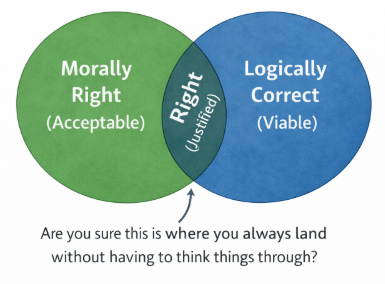
Have you ever proposed something that made perfect logical sense, only to have someone dismiss it as immoral? Or defended something you believed was morally right, only to be told it wasn't logical?
If so, you've experienced one of the biggest problems in modern public discourse. We constantly pit logic against morals or vice versa, as though one can nullify the other. But neither one is enough on its own. An action can be perfectly logical yet still be morally unacceptable. It can also avoid violating any moral principles while still being impossible (illogical). The goal isn't to decide whether logic or morality is more important. It's to recognize that neither one, by itself, is enough to justify anything. To be truly justified, an action must be both logically correct and morally right. That's the standard Dem Agora™ is built around.
A note on terminology: Throughout Dem Agora™, we'll use the phrase "morally right" as a convenient shorthand for "not morally wrong." It's a familiar expression and easier to read, but an action can only be considered morally right if it doesn't violate our shared principles. It's important to note that actions are fundamentally different from objectives. This distinction matters because we frequently assign moral labels to objectives, then assume every action taken in pursuit of those objectives inherits that same moral status. It doesn't. Take a look at the example below:
Helping the homeless is morally right.
Possible actions:
✓ Expand shelters.
✓ Job training.
✓ Mental health care.
✗ Confiscate private property.
✗ Force homeowners to house strangers.
All these actions can help achieve the objective, but two of them are actions that aren't morally right. Our problem is we conflate objectives with actions and mistakenly label them as morally right or morally wrong (as demonstrated in this example). Most times, we aren't even thinking in terms of actions or objectives. Objectives are either worth pursuing or they aren't. Achieving objectives requires specific actions and there's more than one way to do so. Actions are what need to be measured for logic and morality. When we conflate objectives with actions, we create this circular justification that causes the majority of the confusion, arguments and division in our society.
Consider this circular logic: Objective A is morally right and Action A helps achieve Objective A so Action A must be morally right also. But look at the example again. It would not be morally right for government to confiscate your private property to help the homeless, or force you to house strangers. Those would be immoral actions to achieve a desirable objective. We spend so much time arguing about whether our objectives are good that we often forget to examine whether the actions proposed to achieve them are justified. The result is circular reasoning, double standards, and division. Consider some controversial real-world examples.
- Abortion: is this an action or an objective? Does it achieve a higher purpose or is it the desired outcome itself?
- Putting more ICE agents on the streets: is this an action or an objective? Does it achieve a higher purpose or is it the desired outcome itself?
- Equality: is this an action or an objective? Does it achieve a higher purpose or is it the desired outcome itself?
- Border security: is this an action or an objective? Does it achieve a higher purpose or is it the desired outcome itself?
Equality and border security are objectives. Whether someone supports them is a matter of preference. The moral evaluation belongs to the actions proposed to achieve them, not to the objectives themselves. We don't need to defend the morality of our preferences. But we do need to defend the morality of our actions. More importantly, we must reject immoral actions, regardless of how desirable the objective may be. Once we allow objectives to justify violating our principles, those principles cease to protect anyone.
Objectives are preferences. Actions require moral and logical justification. Preferences do not justify actions.
In any society, if this distinction were widely understood, many disagreements would shift from competing moral declarations to precise and meaningful discussions about objectives, actions, logic, and morals.
The distinction between objectives, actions, and morals is only the beginning. Dem Agora™ builds on those concepts by organizing every discussion into four fundamental building blocks: ideals, ideas, actions, and principles. Each serves a different purpose, and understanding those purposes is what allows us to reason clearly, avoid circular arguments, and evaluate proposals consistently.
Ideals replace simple objectives because they don't just describe what we'd like to achieve—they paint a picture of why we'd want to achieve it. They describe the kind of society we want to build and the outcomes we believe are worth pursuing. As we've already established, ideals are preferences. They provide direction, but they never justify actions.
Ideas bridge the gap between ideals and actions. Individual actions are often too small to understand in isolation, but ideas organize related actions into meaningful approaches for moving society closer to an ideal. A single idea may be implemented in many different ways, each requiring its own logical and moral evaluation.
Actions are the specific things we choose to do. Unlike ideals and ideas, actions must always be justified. Every proposed action must demonstrate that it logically advances the idea it supports while remaining consistent with our shared principles.
Principles are the building blocks of our morality. They define the boundaries that no action may cross, regardless of how desirable the ideal or promising the idea may seem. Principles don't tell us what objectives to pursue—they ensure that whatever objectives we pursue, we pursue them fairly.
Ideals provide direction.
Ideas organize solutions.
Actions require justification.
Principles define our moral boundaries.
If you’re willing to take a stand for what’s truly fair and right, regardless of how many likes it costs you, this is where you belong. Tribal allegiances and outrage forums drive social division more than politicians or policies themselves do — and they’ll continue to do so just fine without you. The community that says “no” to all that and strives for something better — that’s the community that will make the most of what you have to offer. That's the community where your input doesn't just become more noise; it helps build a shared roadmap.
Ready to jump in?
You don’t need to know what goes on under the hood to participate.
- Vote on legislation and public proposals.
- Propose your own solutions and principles.
- Give feedback so the best thinking rises and the noise gets filtered out.
How does Dem Agora™ create our shared roadmap?
Dem Agora builds that roadmap by separating the things public debate constantly blends together. Instead of letting everything collapse into one endless argument, the system breaks discussion into a few simple pieces that can be voted on, compared, and improved.
- Objectives (Ideals): what “success” looks like — the outcomes we want to move toward.
- Proposals (Ideas): different approaches people believe could achieve those objectives.
- Actions: the concrete steps required to carry out a proposal.
- Principles: non-negotiable limits — actions that cross them get rejected, even if the goal sounds good.
Once those pieces are separated, people can’t “win” by dodging. The system forces people to deal with the substance: what the objective is, whether the proposal actually gets us there, and whether the actions violate rules we’ve agreed are off-limits. Ideas that aren’t linked to clear objectives are just pointless activities. Ideas that aren’t deconstructed into actions are just wishful thinking. And actions can only be challenged through shared principles — so it’s not just one preference versus another.
Over time, votes and feedback do what circular arguing never can: they narrow uncertainty. The strongest objectives rise, weak proposals lose support, actions get refined, and principles keep the roadmap from sliding into “anything goes.” That’s how the roadmap becomes clear enough to function as a mandate — and clear enough to hold leaders accountable.
Your role stays simple: bring your perspective. Vote, propose, and respond. Dem Agora keeps the structure consistent so we end up with a roadmap we can actually use.
True Justification vs “Ends Justify the Means”
On the left: goals matter, but actions must pass shared standards — first logical correctness, then moral limits. On the right: what we want becomes the standard.
A goal or outcome we'd like to achieve (an Ideal / Objective).
The specific actions or policies we're considering.
We test the action against shared standards — logical correctness and moral limits:
- Is it viable — will it actually work?
- Is the cost reasonable?
- Are the side effects acceptable?
- Is it sustainable?
- Does it violate our Principles (non-negotiable moral limits)?
The action is judged by the standards. Only the intersection survives.
A goal or outcome we'd like to achieve.
The specific actions or policies we're considering.
There are no shared rules, no logical viability test, and no moral limits that constrain the action.
So we circle back to the only thing we have: what we want. “This is what I want, this is what I’ll do, and it feels justified because I want it.”
Because the ends justify the means, the outcome is always the same:
♻️ “Always justified” — everybody is always right, so nothing converges and nothing gets enforced.Dem Agora's job is to keep us anchored to shared standards so “what we want” doesn't quietly become the justification for anything — and so the only things that survive are both logically correct and morally right.
How all the pieces fit together
Under the hood, Dem Agora turns scattered debate into a structured pipeline. Each layer has a job:
What we're aiming for and what we can't break
This is where we define what “solved” looks like and the moral limits we refuse to cross.
- Ideals & Objectives – shared picture of success.
- Principles – non-negotiable moral limits.
Everything above this layer must aim at supported Ideals/Objectives and respect supported Principles.
Turning goals into justified paths
Here we turn “what we want” into candidate ways to get there, test logical correctness, and surface principle conflicts.
- Ideas (Proposals) – possible ways to reach our Objectives.
- Collaborations & Actions – concrete steps and plans.
- Principle Violations – “this crosses a moral line” flags.
- Assertions – defenses or challenges tied to the substance.
This layer filters out double standards and weak logic so only ideas in the intersection remain credible.
Connecting structure to policy and signal
Finally, we line all of this up against reality and capture what people actually support.
- Measures & Public Policy – real bills, rules, and proposals.
- Votes – what people support across the structure.
- Comments – refinements tied to specific layers.
Over time, this becomes a transparent signal: what survives standards, what fails them, and what has real support.
Visually, you can think of it as a stack:
↓ (filter: must aim at our goals and respect our rules)
DESIGN & LOGIC: Ideas, Collaborations, Actions, Violations, Assertions
↓ (filter: must be logically correct and morally right)
REAL WORLD: Measures, Votes, Comments
→ Output: a prioritized, principle-safe to-do list leaders can be held to
Ideals & Objectives — defining what "solved" means
Most debates skip the most important step: agreeing on what a “win” looks like. On Dem Agora, we capture that as Ideals (why it matters) and Objectives (what we're trying to achieve).
- Ideals describe the values and outcomes we care about (e.g., affordability, safety, opportunity).
- Objectives translate those values into concrete, measurable targets we agree are worth pursuing.
- When you propose or vote on Ideals and Objectives, you're helping define what success means for everyone.
Over time, supported Ideals and Objectives become our shared definition of what we're trying to fix — the foundation every logically correct and morally right solution must answer to.
Principles — the rules we can't break
Principles are the guardrails: one-sentence rules and limits that apply universally, before we talk about preferences. They answer the question: “What must we never do, even if most people want it?”
- Each Principle is written to be universal and mirror-tested — no special pleading.
- Principles prevent double standards by forcing the same rule to apply no matter who is involved.
- When you propose or vote on Principles, you're deciding what counts as a legitimate moral limit for everyone.
Ideas and actions that violate supported Principles are flagged and pushed out of the solution set. This is how we keep “logical correctness” from becoming “anything goes.”
Ideas (Proposals) — what we could do
Ideas are proposals: “Here's something we could do to move us toward our objectives.” An Idea matters when it connects to a real objective, can be defended as logically viable, and stays inside our principles.
- Connects clearly to at least one Objective / Ideal.
- Can be defended as logically viable (with trade-offs and reasoning).
- Doesn't violate any of our supported Principles.
When you submit or vote on Ideas, you're shaping a menu of permissible options — not just what sounds good, but what can be both logically correct and morally right.
Assertions & Principle Violations — stress-testing the logic
Even good-sounding Ideas can hide bad logic or moral inconsistency. That's where Assertions and Principle Violations come in.
- Principle Violations: claims that an Action or Idea breaks a supported Principle.
- Assertions: structured defenses or challenges — “This doesn't violate the principle because…” or “Here's why it does.”
- Voting on Violations and Assertions helps surface which arguments are justified and which are just special pleading.
This layer is where justification is vetted. Weak logic and selective standards get exposed. Only ideas backed by consistent reasoning and supported principles remain credible.
Actions & Collaborations — building the to-do list
Collaborations take a strong Idea and break it down into specific Actions — the real steps that would have to happen in the world.
- Each Action is assessed for feasibility, cost, side effects, and sustainability.
- Principle Violations can be raised at the Action level when details cross a moral line.
- Votes on Actions help prioritize what belongs on the short list versus the scrap pile.
As Collaborations develop, we don't just get “good ideas” — we get a prioritized to-do list of concrete Actions that survive logical correctness checks and moral limits.
Measures & Public Policy — connecting structure to the real world
Measures are where this structure meets reality: actual bills, ordinances, resolutions, and policies already in play. You can compare them against our Ideals, Objectives, Principles, and preferred Actions.
- Voting on Measures shows which real-world options the public supports or rejects.
- Comments, Violations, and Assertions on Measures reveal which parts are justified and which are not.
- Over time, Measures can be compared against the community's blueprint — are leaders implementing what survives both standards?
Votes & Comments — turning participation into signal
None of this works without participation. But here, participation isn't just noise — it's structured signal.
- Votes show what Americans prefer across Ideals, Principles, Ideas, Actions, Assertions, and Measures.
- Comments add context and refinements, but stay anchored to a specific part of the structure.
- Over time, this reveals a clear, transparent picture of what the public actually supports — and what it rejects on principle.
From chaos to a transparent blueprint
Put together, the platform becomes a living blueprint:
- Shared Ideals and Objectives define what “solved” looks like.
- Principles set the non-negotiable moral limits and prevent double standards.
- Ideas and Actions provide candidate paths forward that can be tested and refined.
- Assertions and Violations stress-test justification and filter out arbitrary logic.
- Votes and comments show what has real support and what doesn't.
The result is a prioritized, principle-safe to-do list — a set of Actions that can be used to hold leaders accountable: “This is what we agreed on. This is what survives standards. This is what we expect you to do.”
What you can do right now
You don't have to understand every detail under the hood to help build the roadmap. Every small action contributes:
- Vote on Measures, Proposals, and Collaborations to shape what moves forward.
- Propose a Principle, Ideal, or Idea you're willing to apply consistently.
- Raise a Principle Violation when something crosses a line that should apply to everyone.
- Join a Collaboration and help turn a good Idea into a concrete, testable Action plan.